

Fattening calves for beef: a feeding plan, feeds and weight by month
How to fatten calves from a baby calf to slaughter: the stages, how much a calf eats a day, feed mix recipes, a weight-by-month table, acidosis and what 1 kg of gain costs.
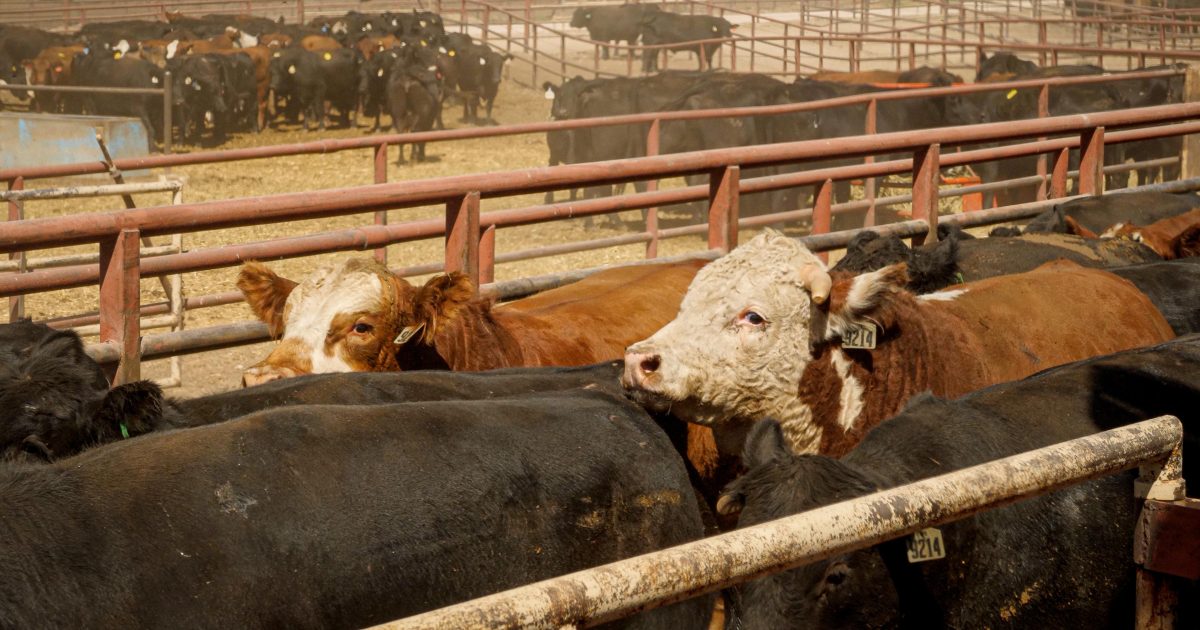
Fattening turns a calf into saleable beef in about a year. The profit comes down to three things: how many kilograms the animal gains a day, how much feed it eats for each kilogram, and whether it stays healthy. This guide walks the whole way, from a baby calf or a weaned calf to slaughter, with tables, example mixes and figures you can check in the ration calculator.
In short: a Holstein bull calf bought at a few weeks old reaches 550–600 kg at about 15–17 months, at an average of about 1.1 kg a day. Purebred beef bulls grow fastest: late-maturing breeds (Limousin, Charolais, Simmental) reach 650–750 kg, while early-maturing ones (Angus, Hereford) are finished at 550–620 kg. Crosses sit in between. A fattening calf eats about 2.1–2.5% of its live weight in dry matter a day. Concentrate goes up in steps of at least 5 days, and forage never falls below 10% of the dry matter. The heavier the animal, the more feed each further kilogram costs.
Which calves to buy for fattening
Baby calf or weaned calf
Two kinds of calves are fattened most often: baby calves from dairy farms, bought at 2–4 weeks, and weaned beef calves from suckler herds.
| Baby calf from a dairy farm | Weaned beef calf | |
|---|---|---|
| Age and weight when bought | 2–4 weeks, 45–60 kg | 6–9 months, 200–300 kg |
| Purchase price | low | high |
| Feed at the start | milk replacer for 7–12 weeks | solid feed straight away |
| Disease risk | high: scour and pneumonia in the first weeks | lower, but weaning and transport are a stress |
| Time to slaughter | 14–17 months | 7–10 months |
| Carcass | lighter, lower killing-out percentage | heavier, better graded |
| Suits | farms with the experience and time for young calves | farms that want a shorter, safer cycle |
A baby calf is cheap to buy but takes more work and skill. A weaned calf costs more, but it reaches sale sooner and carries less risk. Calves under 10 days old may not be transported more than 100 km, and newborns whose navel has not healed are not fit for transport at all [4].
Breed and cross
- Holstein. The bull calves are cheap and easy to find. They grow well on an intensive ration, but they carry less muscle and kill out lower (about 52–54% of live weight), and the carcass grades lower.
- Simmental and Brown Swiss. Dual-purpose breeds carry more muscle than Holsteins and are sought after for fattening.
- Dairy cows crossed with beef bulls: Belgian Blue, Limousin, Charolais, Aberdeen Angus. The calves cost more, but grow faster and the carcass is paid better. Angus crosses lay down fat earlier and are sold at a lower weight.
- Purebred beef calves from suckler cows. They give the best results, usually killing out at about 56–62%. How early- and late-maturing breeds are fattened is covered in the section "Fattening beef breeds" below, and a fuller comparison in our comparison of beef cattle breeds.
Bulls, steers or heifers
- Bulls grow about 8–20% faster than steers, use feed about 13–17% more efficiently and give leaner meat [7]. That is why most intensively fattened male calves in continental Europe are not castrated. Bulls need strong fences and careful handling.
- Steers are calmer and lay down fat earlier. They suit grass-based finishing and beef with more marbling.
- Heifers lay down fat earliest and at the lowest weight. Kept too long on a rich ration, they put on too much fat.
What to check when you buy
- The navel should be dry, soft and not swollen. An unhealed navel lets infection in.
- Colostrum. Ask whether the calf got colostrum in its first hours. Without it, its immunity is weak.
- Health. Bright eyes, a clean nose, no cough, a dry tail with no sign of scour, a strong sucking reflex and steady legs.
- Weight. A Holstein calf should weigh at least about 45–50 kg. Lighter calves fall ill more often.
- Papers. Two ear tags and a passport. Register every movement as your national rules require.
- The fewer sources, the better. Calves gathered from many farms pass diseases to each other. Keep newcomers apart for at least 2–3 weeks and talk to your vet about vaccines.
Calf fattening plan: the four stages
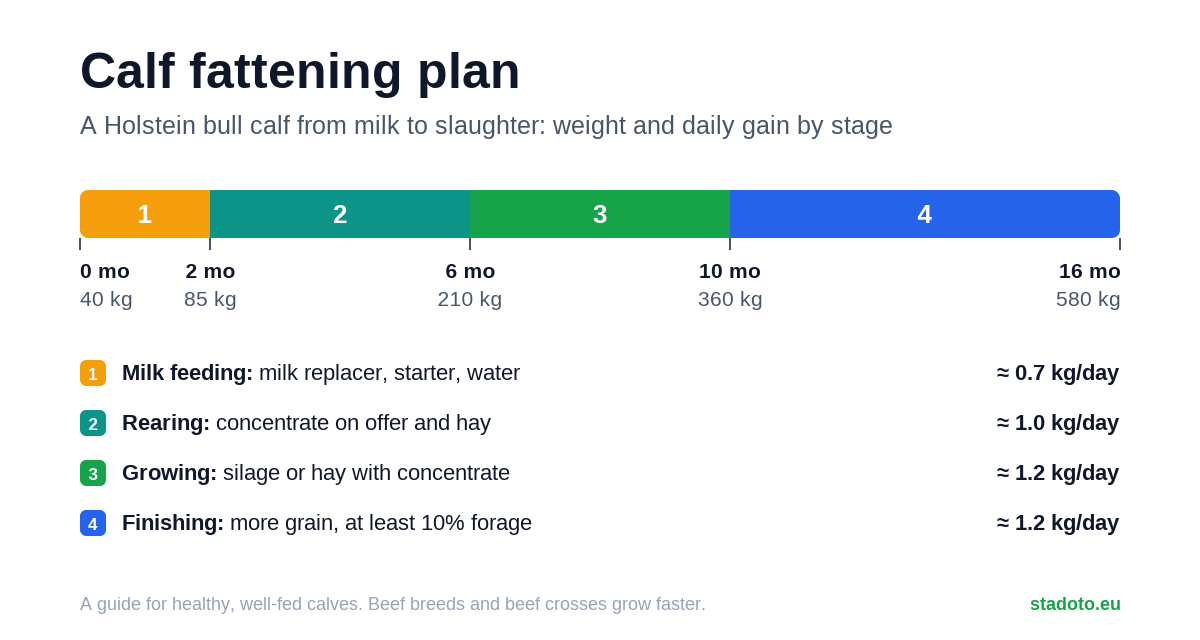
| Stage | Age | Weight | Daily gain | Main feed |
|---|---|---|---|---|
| 1. Milk feeding | 0–2 months | 40–85 kg | 0.6–0.8 kg | milk replacer, starter, water, a little hay |
| 2. Rearing | 2–6 months | 85–210 kg | 0.9–1.1 kg | up to 3–4 kg of concentrate a day, hay or straw |
| 3. Growing | 6–10 months | 210–360 kg | 1.1–1.3 kg | maize silage or hay with concentrate |
| 4. Finishing | 10 months to slaughter | 360–600 kg | 1.1–1.4 kg | more grain, at least 10% forage |
The ages are for a Holstein bull calf bought as a baby calf. A weaned beef calf goes straight into stage 3.
Stage 1: the baby calf (0–8 weeks)
This is the riskiest stage: most calves are lost here, to scour and pneumonia. The calf needs colostrum within 2 hours of birth [1], then 7–12 weeks of milk or milk replacer at about 13–15% of its birth weight a day. It needs water and starter from the first week [1], and a little hay or straw from the second [3]. It is weaned when healthy, over 85 kg and eating at least 1 kg of starter a day for three days in a row [2]. The day-by-day plan, how to mix milk replacer and what to do about scour are in a separate article on feeding baby calves.
Stage 2: rearing (2–6 months)
After weaning, the calf eats concentrate (mix 1 below or a bought calf ration) up to about 3–3.5 kg a day, with good hay or straw on offer and water. At about 150 kg, change over gradually to mix 2. Gains dip for the first 2–3 weeks after weaning, which is normal, and then come back to about 1 kg a day. Talk to your vet about coccidiosis and worming, above all if the calves go out to grass.
Stage 3: growing (210–360 kg)
This stage is for frame and muscle, not fat. There are two main ways:
- Silage-based: maize silage on offer and 2–3 kg of concentrate. Silage is low in protein (about 8% of the dry matter), so the concentrate has to bring the protein, for example sunflower or soybean meal.
- Cereal-based: a concentrate mix (mix 2) and 1–1.5 kg of hay or straw.
Good silage can carry most of the ration. In a Bulgarian trial by the Institute of Animal Science in Kostinbrod and the experimental station in Vidin, Bulgarian Simmental bulls fattened to 550 kg grew fastest on a ration of 20% concentrate and 80% maize silage: 1,268 g a day. On 26% concentrate they gained 1,219 g a day [8].
Stage 4: finishing (360 kg to slaughter)
The ration gets richer in energy. On a cereal system, concentrate goes up to 75–85% of the dry matter; on silage, to about 55%. Forage never falls below 10% of the dry matter, and on a small farm it is safer to stay above 15%.
Gains do not stay level through finishing. In a Teagasc trial, Charolais-cross steers on a high-concentrate ration gained 1.42 kg a day over the first 12 weeks and only 1.16 kg over the next 11 weeks, while eating 12% more concentrate. The concentrate needed per kilogram of gain rose from 7.2 to 9.9 kg of dry matter [7]. An animal is finished when it carries fat over the ribs, the tailhead and the brisket. Holstein bulls usually get there at 550–600 kg; for the beef breeds it depends on how early they mature (see the next section).
Fattening beef breeds
Purebred beef calves usually come from suckler herds. They suckle until 6–8 months and go straight into stage 3 at 200–300 kg. Compared with Holsteins they eat less feed per kilogram of gain and give a more muscular carcass, and the late-maturing breeds also grow faster and kill out higher [12]. The biggest difference between the breeds themselves is how early they mature, that is, at what weight they start to lay down fat.
- Early-maturing breeds: Aberdeen Angus and Hereford. They lay down fat earlier and at a lower weight, so bulls are finished at 550–620 kg, and steers and heifers earlier still. They suit finishing with more forage and grass, and beef with marbling. Kept on a rich ration up to the weights of the late-maturing breeds, they get too fat and every further kilogram costs dear.
- Late-maturing breeds: Limousin, Charolais and Simmental. They grow faster and for longer and stay lean to a higher weight, so they are fattened to 650–750 kg. They want more energy and protein all through: keep them on mix 2 up to about 400 kg. On a poor ration they grow but do not lay down enough fat, and an underfinished carcass is paid less.
| Breed | Type | Gain in fattening | Slaughter weight, bulls | Age at slaughter | Suits |
|---|---|---|---|---|---|
| Aberdeen Angus | early-maturing | 1.1–1.4 kg | 550–620 kg | 15–18 months | cereal or more forage; steers and heifers also at grass |
| Hereford | early-maturing | 1.0–1.2 kg | 550–650 kg | 15–18 months | forage and grass with moderate grain |
| Limousin | late-maturing | 1.2–1.5 kg | 600–700 kg | 15–18 months | intensive, silage or cereal |
| Charolais | late-maturing | 1.3–1.6 kg | 650–780 kg | 16–19 months | intensive, silage or cereal |
| Simmental | late-maturing | 1.2–1.7 kg | 600–780 kg | 16–19 months | silage; copes with more forage too |
The values are a guide, from the Bulgarian beef breeders' association [14] and the trials below. They depend a lot on the bloodline, sex and ration.
In Teagasc trials with bulls on a high-concentrate ration, Angus and Hereford used feed least efficiently, Charolais and Limousin most efficiently, and Simmental came in between. The gap between the least and the most efficient breed was about 14% [12]. In a Bavarian trial, modern Simmental (Fleckvieh) bulls reached 780 kg at about 16 months, gaining 1.6–1.7 kg a day on average, with no fall in muscle, so fattening them to a high weight is recommended there [13].
Dairy cows crossed with beef bulls sit between the Holstein and the beef breeds. What is said about early-maturing breeds holds for Angus crosses, and what is said about late-maturing breeds for Belgian Blue, Limousin and Charolais crosses.
How much a calf eats a day
Intake depends mostly on weight. Dry matter is the feed without its water. That is why 10 kg of maize silage gives only about 3.3 kg of dry matter, as much as 3.8 kg of maize grain (more in the article on marbled beef from Black Angus).
| Live weight | Dry matter a day | Cereal ration, as fed | Of which forage | Water a day |
|---|---|---|---|---|
| 100 kg | 2.5–3 kg | about 3–3.5 kg | 0.3–0.5 kg | 8–15 l |
| 200 kg | 4.8–5.2 kg | about 5.5–6 kg | about 1 kg | 15–35 l |
| 300 kg | 7–7.5 kg | about 8–8.5 kg | 1–1.3 kg | 20–50 l |
| 400 kg | 9–9.5 kg | about 10–11 kg | 1.2–1.5 kg | 25–60 l |
| 500 kg | 10.5–11.5 kg | about 12–13 kg | 1.4–1.7 kg | 30–70 l |
| 600 kg | 12–13 kg | about 14–15 kg | 1.5–2 kg | 35–80 l |
Cattle drink less in cool weather and more in the heat [11]. With silage the ration weighs much more as fed, because maize silage is two-thirds water: a 300 kg steer eats about 16 kg of ration with 12 kg of silage in it.
Feed mix recipes for fattening
Here are three example mixes from feeds you can buy almost anywhere, 100 kg each. Swap in your own ingredients and check the ration in the calculator.
| Ingredient, kg | Mix 1: weaning to 150 kg | Mix 2: growing, 150–350 kg | Mix 3: finishing, over 350 kg |
|---|---|---|---|
| Maize, coarsely ground | 38 | 35 | 46 |
| Barley, coarsely ground | 25 | 33 | 32 |
| Sunflower meal | 15 | 18 | 14 |
| Soybean meal | 17 | 8 | 4 |
| Wheat bran | 2 | 3 | – |
| Feed limestone | 1.5 | 1.5 | 1.5 |
| Salt | 0.5 | 0.5 | 0.5 |
| Cattle premix | 1 | 1 | 1 |
| Sodium bicarbonate | – | – | 1 |
| Crude protein in the mix | about 18% | about 16% | about 13% |
| Metabolisable energy, MJ per kg of dry matter | about 12.4 | about 12.3 | about 12.4 |
| How much a day | up to 3–3.5 kg, hay on offer | 4.5–7 kg and 1–1.3 kg of hay | 9–11 kg and 1.3–1.5 kg of straw |
- Protein is given as on a label, in the feed as fed. Sunflower meal is counted at about 36% protein in the dry matter; if yours is richer, cut the soybean meal.
- Grain is ground coarsely or rolled. Fine meal ferments too fast in the rumen and raises the risk of acidosis.
- Limestone is not optional. Grain is rich in phosphorus and poor in calcium, and a calcium-to-phosphorus ratio of about 2:1 protects bulls and steers from urinary stones [9].
- Premix goes in at the rate on its label: 0.5% for some, 2% for others. Do not add a second premix on top.
- Bicarbonate buffers the rumen on high-grain rations.
- For the calculator, enter a mix as "Other concentrate": dry matter 88%, metabolisable energy 12.4 / 12.3 / 12.4 MJ, crude protein 20.5 / 18 / 14.9% of dry matter and NDF 20 / 21 / 19% for mixes 1, 2 and 3.
If you buy a ready-made fattening ration, compare its label with the table.
Example daily rations
| Animal and target | Ration a day, as fed | Dry matter | Protein, % of DM | Forage, % of DM | Energy is enough for |
|---|---|---|---|---|---|
| 200 kg, 1.1 kg a day | mix 2: 4.8 kg; meadow hay: 1 kg | 5.1 kg | 16.5 | 17 | 1.09 kg a day |
| 300 kg, 1.2 kg a day | maize silage: 12 kg; hay: 0.8 kg; barley: 2 kg; sunflower meal: 1.2 kg; soybean meal: 0.3 kg | 7.7 kg | 14.2 | 60 | 1.25 kg a day |
| 450 kg, 1.3 kg a day | mix 3: 9.8 kg; wheat straw: 1.3 kg | 9.8 kg | 13.6 | 12 | 1.33 kg a day |
| 450 kg, 1.3 kg a day | maize silage: 12 kg; straw: 0.5 kg; maize grain: 3.2 kg; barley: 1.5 kg; sunflower meal: 1.8 kg | 10.1 kg | 13.0 | 44 | 1.37 kg a day |
The rations are worked out with the equations of the advanced calculator and its feed values. Add minerals to the silage rations at the rate on the premix label. With weaker silage or hay the same amounts give less, so enter your own feeds, and your analysis if you have one. The easy calculator on the same page suggests a ration for each stage from five simple questions.
Weight by month
| Age | Holstein, bought as a baby calf | Early-maturing beef: Angus, Hereford | Late-maturing beef: Limousin, Charolais, Simmental |
|---|---|---|---|
| birth | 40 kg | 35 kg | 40 kg |
| 1 month | 60 kg | 65 kg | 70 kg |
| 2 months | 85 kg | 95 kg | 105 kg |
| 3 months | 110 kg | 125 kg | 140 kg |
| 4 months | 140 kg | 155 kg | 175 kg |
| 6 months | 210 kg | 220 kg | 245 kg |
| 8 months | 285 kg | 275 kg | 305 kg |
| 10 months | 360 kg | 345 kg | 390 kg |
| 12 months | 435 kg | 420 kg | 475 kg |
| 14 months | 510 kg | 495 kg | 560 kg |
| 16 months | 580 kg | 565 kg | 645 kg |
| 18 months | 640 kg | 625 kg | 725 kg |
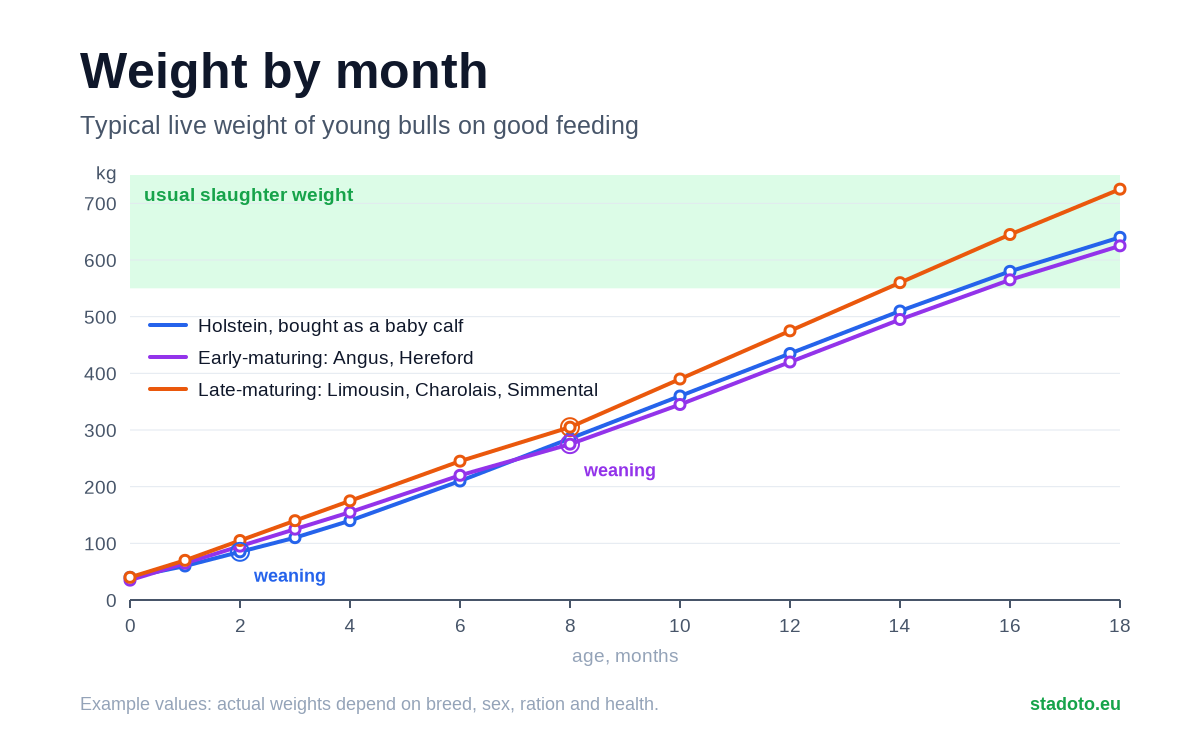
The values are a guide for healthy young bulls on good feeding. Beef calves suckle until 7–8 months and grow fast up to weaning, then their gains dip for a few weeks. The Holstein starts slower, but on an intensive ration it grows almost as fast as the early-maturing beef breeds: the difference in growth is small, but the beef breeds eat less and give a better carcass [12]. Late-maturing bulls grow fastest and to the highest weight. Crosses sit between the Holstein and the beef breeds.
Do not guess weights by eye. Weigh the calves every 4–6 weeks, at the same time of day, before feeding. Without scales, the cattle weight calculator estimates weight from the heart girth measured with a tape. The daily weight gain calculator works out the gain between two weighings. If a group lags the table by more than 15–20% for a whole month, look for the cause in health, the ration, water or space at the trough.
Fast fattening: what is realistic
No healthy fattening gives 2 kg a day for months on end. On good feeding, real gains are 1.1–1.6 kg a day depending on the breed (see the table in the section on beef breeds). Products that promise much more are either banned or useless:
- Hormones and beta-agonists for growth are banned for farm animals in the EU [5].
- Antibiotics as growth promoters have been banned in feed in the EU since 2006 [6]. An antibiotic is given only for treatment, on a vet's prescription and with its withdrawal period.
What really speeds up gains:
- A healthy calf. One bout of pneumonia can cost weeks of growth.
- Enough energy and protein for the weight and stage.
- Water on offer, clean and unfrozen. Cattle that drink less eat less.
- Space at the trough for every animal, and feed at the same times every day.
- Calm and comfort: dry bedding, a well-ventilated house, groups not mixed again and again.
- Parasite control for animals that graze.
Buffers and live yeast can help the rumen on high-grain rations, but they do not replace a balanced ration.
Acidosis and the other diseases of fattening
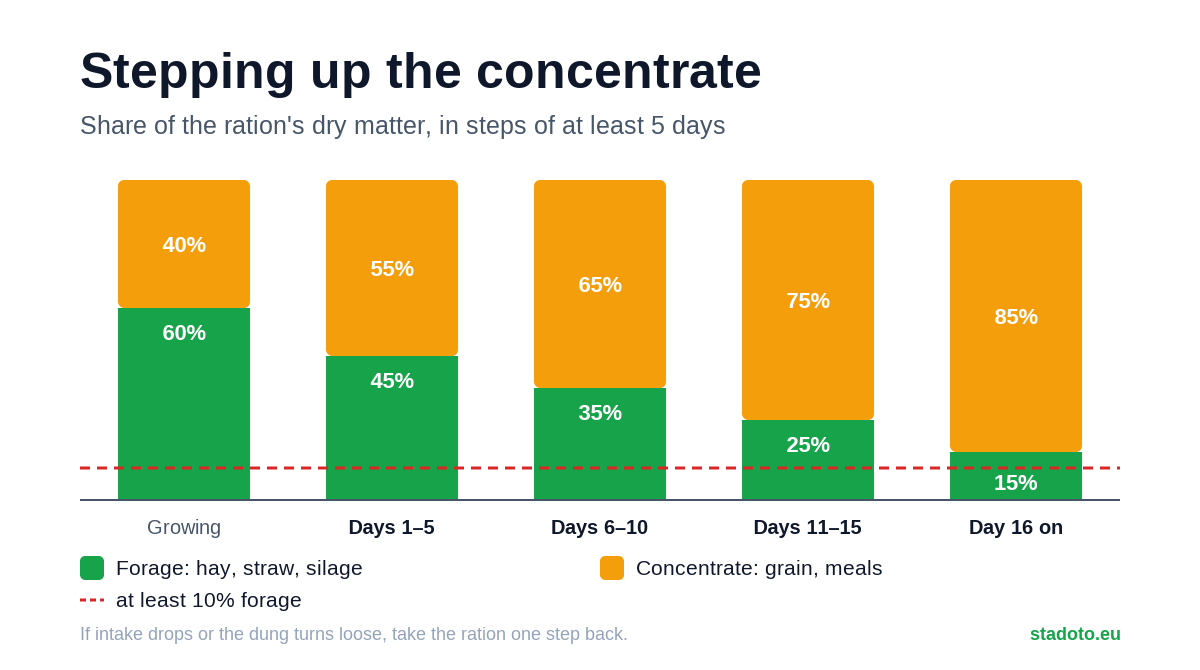
- Acidosis. The cause is too much grain too fast: acid builds up in the rumen and the animal goes off its feed [10]. The signs are uneven eating, loose greyish dung, and later lameness and bloat. Guard against it with concentrate raised in steps of at least 5 days, at least 10% forage (15% is safer), coarsely ground grain and feeding at the same times. Never let cattle get into the grain store.
- Bloat. A swollen left flank is an emergency. Call the vet at once.
- Urinary stones. More common in bulls and steers on cereal rations. Calcium to phosphorus of about 2:1, salt in the ration and plenty of clean water protect against them [9].
- Pneumonia. The commonest disease of young fattening cattle, above all after transport and mixing groups. Ventilation without draughts, dry bedding and vaccines agreed with your vet all help.
What 1 kg of gain costs, and when to sell
The feed cost of 1 kg of gain is the cost of the daily ration divided by the daily gain. Here is an example with example feed prices (put in your own):
| Feed | Example price |
|---|---|
| Maize grain | €0.22 a kg |
| Barley | €0.20 a kg |
| Sunflower meal | €0.30 a kg |
| Soybean meal | €0.50 a kg |
| Premix | €2.00 a kg |
| Meadow hay | €0.12 a kg |
| Wheat straw | €0.06 a kg |
| Maize silage | €0.05 a kg |
At these prices mix 3 costs about €0.26 a kg. The cereal ration of a 450 kg steer costs about €2.58 a day, and at 1.3 kg a day 1 kg of gain comes to about €2.0 of feed. The silage ration for the same animal costs about €2.17 a day, about €1.7 per kg of gain. If you grow your own silage, it is often the cheapest way.
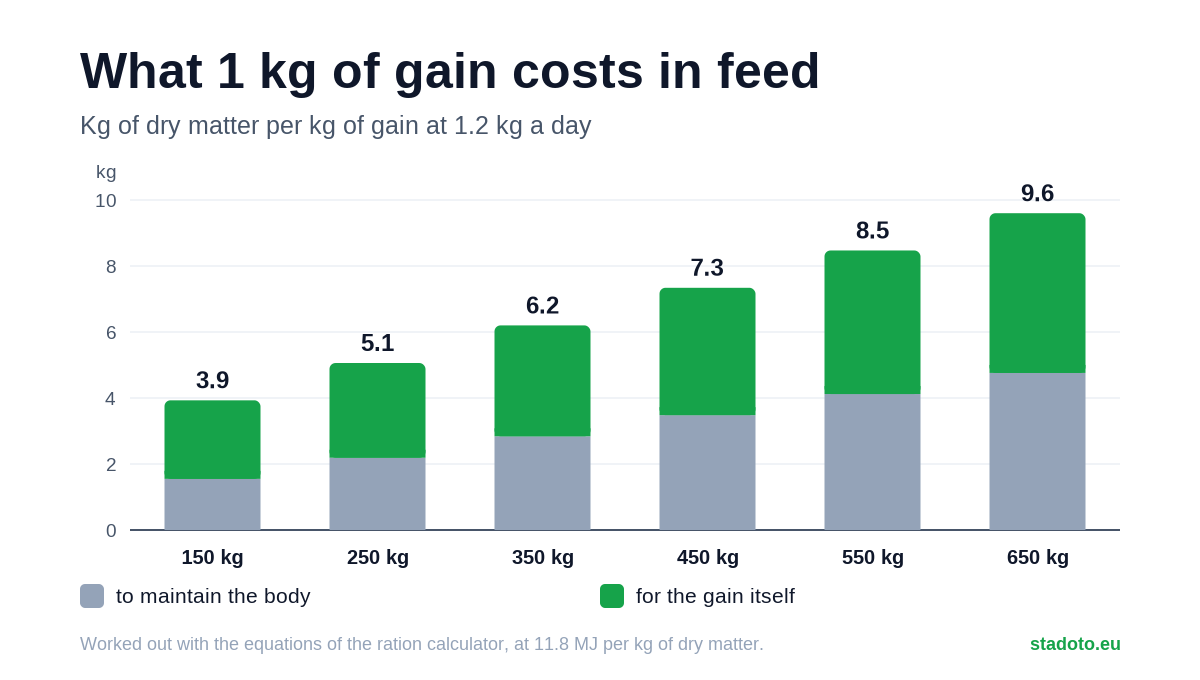
A heavy animal spends more feed just maintaining its body, and its gain holds more fat. So every further kilogram costs more. At the prices above, the feed for 1 kg of gain is about €1.6 at 350 kg, €1.9 at 450 kg, €2.25 at 550 kg and about €2.5 at 650 kg. Compare that with what you get for a kilogram of live weight. Add the other costs too: the vet, bedding, labour, water and power, losses from deaths, and the price of the calf itself.
At sale, the slaughterhouse grades the carcass on conformation (SEUROP) and on fat cover from 1 to 5. Overfat carcasses are often paid less, so ask your buyer what pays best before you decide how long to finish.
How to follow fattening in Stadoto
Record every weighing with Quick weighing and see the gain of each animal and group in Growth analysis. In Feeding and costs you save your feeds and rations, assign them to groups and see what each kilogram of gain cost. Treatments and withdrawal periods before sale are in Health and withdrawal periods.
Frequently asked questions
How long does it take to fatten a calf?
A Holstein bull calf bought as a baby calf reaches 550–600 kg at about 15–17 months. A weaned beef calf of 250–300 kg is fattened for another 7–10 months: early-maturing breeds to 550–620 kg, late-maturing ones to 650–750 kg. Finishing on grass alone, without concentrate, takes 24 months or more.
How many kilograms does a calf gain a day?
About 0.6–0.8 kg a day on milk, about 1 kg after weaning and 1.1–1.4 kg a day in fattening, depending on breed, sex and ration. Late-maturing beef bulls (Limousin, Charolais, Simmental) gain 1.3–1.6 kg. Bulls grow faster than steers and heifers.
How much does a calf weigh at 6 months?
A well-reared Holstein bull calf weighs about 200–220 kg. A calf of an early-maturing beef breed (Angus, Hereford) suckling its mother weighs about 200–240 kg, and one of a late-maturing breed (Limousin, Charolais, Simmental) about 230–280 kg.
How much feed does a calf eat up to slaughter?
A Holstein bull from weaning (about 85 kg) to about 580 kg eats about 3 tonnes of dry matter. That is about 3.5 tonnes of cereal ration including the straw. Before that, on milk, the calf drinks about 26 kg of milk replacer. With silage the ration weighs about twice as much as fed, because silage holds a lot of water.
How much hay does a cow eat a day?
A 600 kg beef cow eats about 12–14 kg of dry matter a day. On hay alone, that is about 14–16 kg of hay. Dairy cows eat more, and coarse, old hay is eaten less.
Can a calf be fattened on hay and grass alone?
Yes, but slowly. On good grass and hay, calves gain about 0.6–0.9 kg a day and reach slaughter weight at about 2 years. This way suits steers and early-maturing breeds such as Angus and Hereford. Holstein bulls on forage grow slowly and are hard to finish.
What should I feed a calf to make it grow faster?
A balanced ration that covers the energy and protein for its weight, and water on offer. Health and a steady feeding routine matter even more. There are no miracle additives, and hormones and antibiotics for growth are banned.
Baby calf or weaned calf: which pays better?
It depends on the farm. A baby calf is cheap, but needs milk replacer, daily attention and a longer cycle, and losses are higher. A weaned calf costs more, but reaches sale sooner with less risk. Work out both with your own prices.
Sources
- Teagasc – Teagasc Calf Rearing Manual, section 3 Milk feeding.
- Teagasc and Animal Health Ireland – The Simple 1,2,3 of Calf Rearing.
- Council Directive 2008/119/EC laying down minimum standards for the protection of calves – EUR-Lex.
- Council Regulation (EC) No 1/2005 on the protection of animals during transport – EUR-Lex, Annex I.
- Council Directive 96/22/EC concerning the prohibition on the use in stockfarming of certain substances having a hormonal or thyrostatic action and of beta-agonists – EUR-Lex.
- Regulation (EC) No 1831/2003 on additives for use in animal nutrition – EUR-Lex.
- M. McGee, Teagasc (2014) – Feed Efficiency in Beef Finishing Systems, slides.
- M. Mikhajlova-Toneva, P. Stojkov (2010) – "Efficiency of calf fattening of Bulgarian Simmental breed with different rations up to 550 kg weight", Agricultural Economics and Management (Bulgaria) 55 (5): 59–65, in Bulgarian – AGRIS.
- MSD Veterinary Manual – Prevention of Common Nutrition-Related Disorders in Beef Cattle.
- MSD Veterinary Manual – Grain Overload in Ruminants.
- National Academies of Sciences, Engineering, and Medicine (2016) – Nutrient Requirements of Beef Cattle, 8th Revised Edition.
- M. McGee, Teagasc (2014) – Feed Efficiency in Beef Finishing Systems, paper.
- A. C. Honig et al., LfL Bayern (2021) – Grobgewebliche und chemische Zusammensetzung von Fleckviehbullen im Wachstumsverlauf, in German.
- Association for Breeding Beef Cattle Breeds in Bulgaria – Breeds, in Bulgarian.
Photos: Preston Keres, USDA, public domain (cover, calf on a bottle). Charts by Stadoto.
This is general guidance for healthy animals. Before you change the feeding, check the ration with a ruminant nutritionist, and agree treatments and vaccines with your vet. Facts last checked: 14 November 2026.