

Feeding a baby calf: colostrum, milk replacer and weaning
How to feed a calf from birth to weaning: colostrum by the 1-2-3 rule, how much milk and milk replacer a day, a day-by-day plan, starter, water, hay, weaning and what to do about scour.
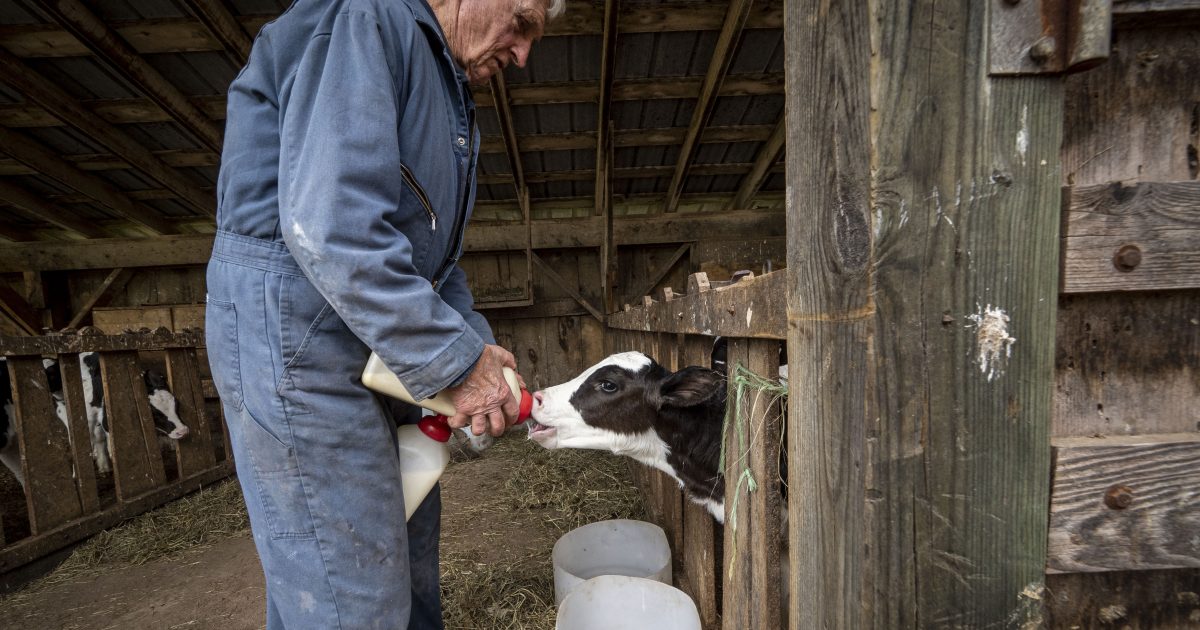
The first two months decide a great deal for a calf. It is at its most vulnerable then, and its growth and health in that time show in everything that follows. This guide is for calves reared without their mother: born on your farm or bought as baby calves for fattening. What comes after weaning is covered in our guide to fattening calves.
In short: colostrum from the first milking, within 2 hours of birth, about 3 litres. Then milk or milk replacer at about 13–15% of birth weight a day (5–6 litres for a 40 kg calf), usually mixed at 125 g per litre. Water and starter from day 3, straw or hay from the second week. Wean when the calf is healthy, weighs over 85 kg and has eaten at least 1 kg of starter for three days in a row.
Colostrum: the first 2 hours
A calf is born with almost no protection against disease. It gets its antibodies from colostrum, and its gut takes them up best in the first hours after birth. Calves that get enough colostrum in time fall ill less and thrive better [2].
The 1-2-3 rule [2]:
- colostrum from the first milking;
- within 2 hours of birth;
- about 3 litres of clean milk.
Beef cows and older, lower-yielding dairy cows usually have colostrum richer in antibodies. The second to eighth milkings are no longer colostrum but transition milk, with fewer antibodies [2]. It is still useful in the first days: give the calf at least four feeds of transition milk [1].
- If the calf will not suck, give the colostrum by bottle. A weak calf that cannot drink is fed by stomach tube, but that should be done by someone experienced or by the vet.
- Feed colostrum and milk from the calf's own mother or from a cow you know to be healthy. Pooled colostrum from many cows is a serious risk for spreading Johne's disease [2].
- If you buy a baby calf, ask whether it got colostrum. What else to check is in the buying section of our fattening guide.
Whole milk or milk replacer
After transition milk, the calf can drink whole milk up to weaning or move to milk replacer. On a good replacer, mixed correctly, calves grow as well as on whole milk [1]. Replacer also protects against diseases spread through milk, such as Johne's [1].
- Replacer quality. Choose a replacer with about 25% protein from milk ingredients [2]. The powder should be cream-coloured. Orange-brown powder that smells burnt has overheated in storage and lost some of its value [1].
- No waste milk. Milk from treated cows and cows with mastitis carries a lot of bacteria. If it holds antibiotic residues, calves drink it reluctantly and grow worse, and more antibiotic-resistant bacteria turn up in their dung [1]. Avoid feeding it [2].
How much milk a day, and how to mix it
In the first week a calf drinks milk at about 10–13% of its birth weight, and 13–15% after that [1]:
| Birth weight | Milk a day | Powder a day at 125 g per litre |
|---|---|---|
| 35 kg | 4.5–5.5 l | 560–690 g |
| 40 kg | 5–6 l | 630–750 g |
| 45 kg | 6–7 l | 750–880 g |
| 50 kg | 6.5–7.5 l | 810–940 g |
- Mixing. Usually 125 g of powder and 875 ml of water make 1 litre of milk [1]. Some replacers are mixed stronger, up to 150 g per litre [2], so follow the label. Weigh the powder on scales, not by eye. Stir the powder into half the water, then top up to the mark [1].
- Temperature. Makers usually recommend 35–38 °C. Milk can be fed cooler, but keep the temperature the same every day: not warm one day and cold the next [1].
- Cold weather. Below about 10 °C a calf burns energy keeping warm, so give it more milk [2].
- Feeds a day. Feed milk twice a day at least until 4 weeks old [2]. If you move to once a day after that, the calf must have starter on offer: the law requires at least two feeds a day [3]. Calves fed milk once or twice a day grow the same [1].
- Teat or bucket. Sucking from a teat closes the oesophageal groove, so the milk goes straight to the abomasum rather than the undeveloped rumen. Sucking also brings more saliva [1].
- Hygiene. Wash buckets and teats after every feed, and never add fresh milk to old milk [1].
Day-by-day feeding plan
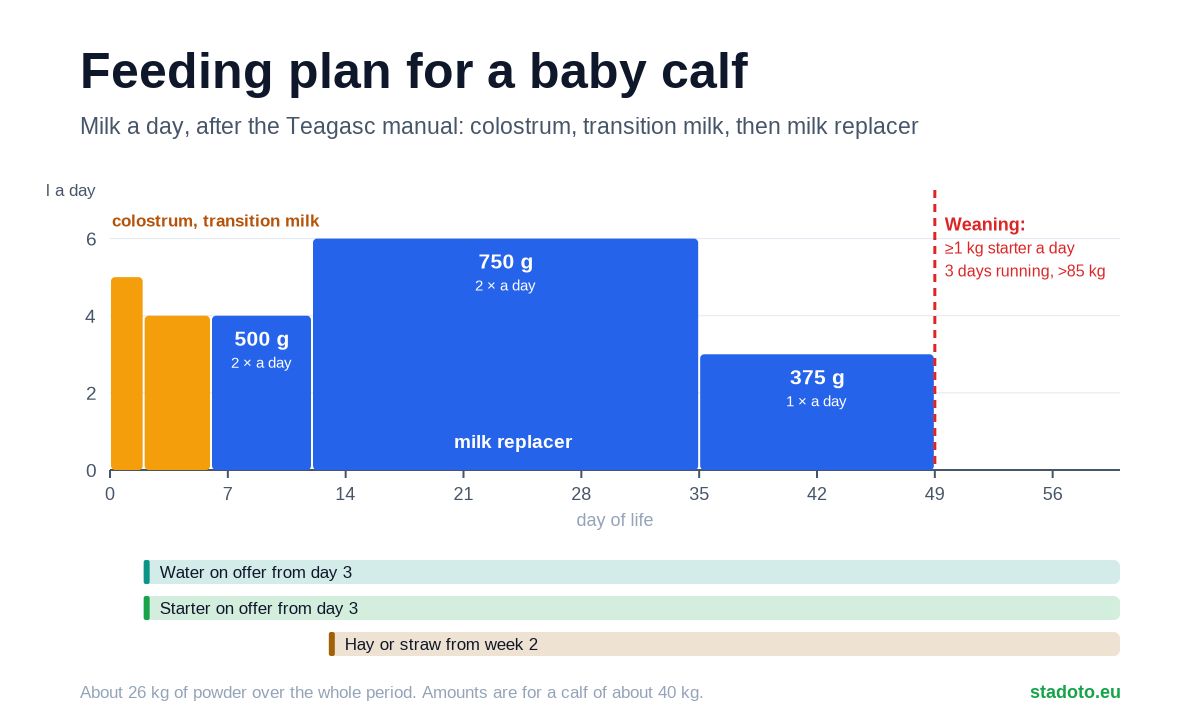
The plan is from the Teagasc manual for bucket feeding, for a calf of about 40 kg [1]:
| Days | Milk a day | Feeds a day | Starter |
|---|---|---|---|
| 1–2 | colostrum: 3 l at the first feed, then 2 l | 2–3 | – |
| 3–6 | transition or whole milk, 2 × 2 l | 2 | a handful |
| 7–12 | 500 g of replacer in 4 l | 2 | on offer |
| 13–35 | 750 g of replacer in 6 l | 2 | on offer |
| 36–49 | 375 g of replacer in 3 l | 1 | on offer |
| 50 on | no milk | – | on offer, up to 2 kg a day |
Over the whole period a calf drinks about 26 kg of powder. If a calf is not eating as much starter as it should, do not stop the milk by the calendar: stretch the last step until the calf meets the weaning conditions.
Starter, water and hay: how the rumen grows
At birth only the abomasum, the fourth stomach, works. The rumen develops as the calf eats solid feed and drinks water [1]. That is why starter and water matter as much as milk.
- Water. Clean water on offer from day 3, changed every day [2]. Without water a calf eats less starter and its rumen develops more slowly. The law requires water for every calf over two weeks old [3].
- Starter. Put out calf starter from day 3 to 5, preferably a coarse mix, with about 12 MJ of energy and 18–20% crude protein [2]. Give a handful at first and replace it every day so it stays fresh. Intake rises slowly and reaches 1–1.5 kg a day around weaning.
- Straw or hay. Teagasc recommends clean barley straw on offer [2]. The law requires every calf over two weeks old to get a little fibrous feed every day [3].
Weaning
Wean the calf when [2]:
- it is healthy;
- it has eaten at least 1 kg of starter a day for three days in a row;
- it weighs over 85 kg.
This is usually between 7 and 12 weeks old, depending on how fast the calf takes to starter. Gradual weaning is better than abrupt [2]: in the plan above the milk is halved for the last two weeks. Do not wean in the same week as transport, dehorning, castration or a move to a new group. After weaning the calf eats starter or a concentrate mix up to about 2 kg a day and more. How feeding goes on is covered in our guide to fattening calves.
Good targets for calves up to 3 months old are an average gain of 0.7–0.8 kg a day and fewer than 3% dying [2].
Housing
Calves may be kept in individual pens up to 8 weeks of age, and in groups after that [3]. The bedding should be dry and deep, and the house well ventilated without draughts. Cold, damp and draughts drain energy and open the door to pneumonia.
Scour and other problems
Scour is the commonest problem in the first weeks. Viruses, bacteria and parasites cause it, and the calf loses water and salts with it: up to 10 litres a day [2]. Teagasc recommends three steps [2]:
- Separate the sick calf so it does not infect the others.
- Rehydrate. Give one or two extra feeds a day of 2 litres of oral electrolytes, between the milk feeds. Electrolytes are the most important treatment.
- Keep feeding milk in the normal amounts as long as the calf will drink. Milk does not prolong scour; it helps the gut heal.
Call the vet if the calf stops sucking, lies down, has sunken eyes, blood in the dung or a temperature. Coughing, a runny nose, fast breathing and going off feed are signs of pneumonia and also need the vet.
Bought-in calves carry the greatest risk of bringing new diseases onto the farm [2]. Keep them apart from the other animals and buy from as few farms as you can.
How to follow growth
Weigh the calf at birth or purchase and at weaning. Without scales, the cattle weight calculator estimates weight from the heart girth, and the daily weight gain calculator works out the gain between the two weighings. In Stadoto, weighings are recorded with Quick weighing, and treatments and withdrawal periods in Health and withdrawal periods.
Frequently asked questions
How much milk does a calf drink a day?
About 13–15% of its birth weight, split into two feeds. For a 40 kg calf that is 5–6 litres a day. In the first week a little less, about 10–13%.
How many grams of milk replacer go into a litre?
Usually 125 g of powder per litre of made-up milk, that is 125 g of powder and 875 ml of water. Some replacers are mixed up to 150 g per litre, so follow the label and weigh the powder.
How long is colostrum fed?
Colostrum from the first milking is fed within the first 2 hours of birth, about 3 litres. Then, in the first days, the calf drinks transition milk from the second to eighth milkings: at least four feeds.
Can a calf drink cow's milk instead of milk replacer?
Yes. Whole milk is a good feed up to weaning. Do not feed milk from treated cows or cows with mastitis. Replacer is handy when the milk is for sale, and it protects against diseases spread through milk.
When does a calf start eating hay and feed?
Starter and water go in from day 3, and straw or hay from the second week. At first the calf only tastes them; by weaning it eats 1–1.5 kg of starter a day.
When is a calf weaned?
When it is healthy, weighs over 85 kg and has eaten at least 1 kg of starter a day for three days in a row. Usually between 7 and 12 weeks. Wean gradually by cutting down the milk.
What should I do if a calf has scour?
Separate it, give it one or two extra feeds a day of 2 litres of electrolytes between the milk feeds, and keep feeding milk as long as it will drink. Call the vet if the calf stops sucking, lies down, has sunken eyes, blood in the dung or a temperature.
Sources
- Teagasc – Teagasc Calf Rearing Manual, section 3 Milk feeding.
- Teagasc and Animal Health Ireland – The Simple 1,2,3 of Calf Rearing.
- Council Directive 2008/119/EC laying down minimum standards for the protection of calves – EUR-Lex.
Photo: Preston Keres, USDA, public domain (Wikimedia Commons). Chart by Stadoto.
This is general guidance for healthy calves. Agree treatments, vaccines and worming with your vet. Facts last checked: 15 November 2026.