

Marbled beef from Black Angus: feeding and finishing for marbling
What marbling is and what drives it: genetics, castration, growth without setbacks, energy in finishing and health. How to feed and finish Black Angus for marbled beef, and when it pays. With a free ration calculator.
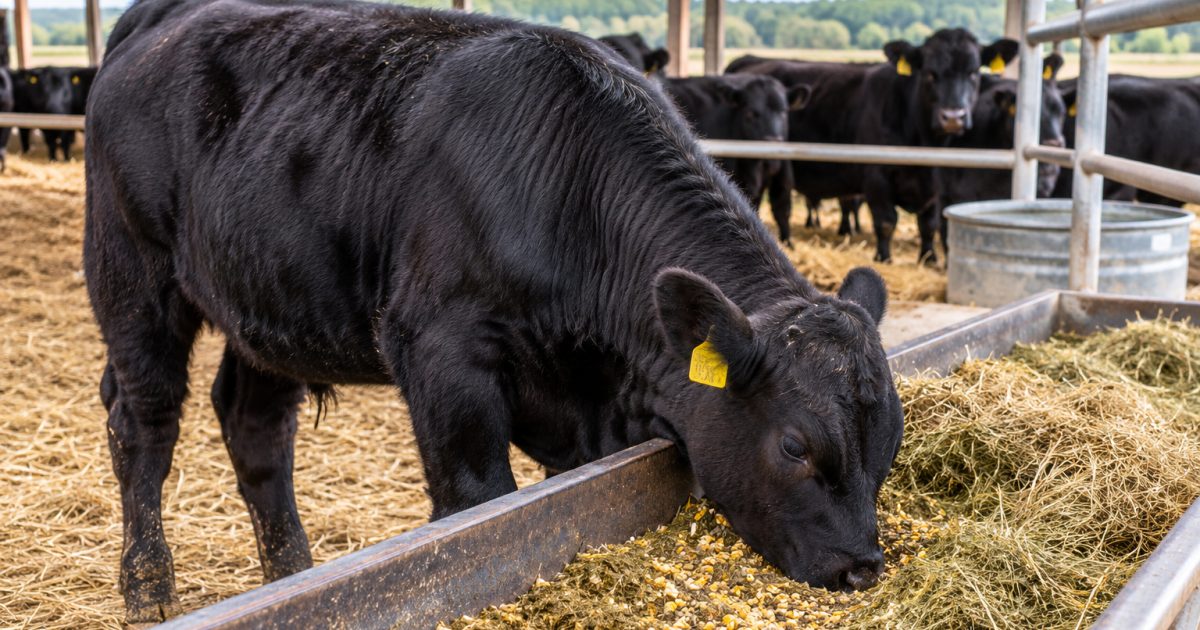
Black Angus is the black Aberdeen Angus, a breed known for its marbled beef. Marbling is the fat inside the muscle: the fine white flecks in a cut ribeye. It makes beef juicier and tastier, and it is the main trait by which beef is graded in the US [6]. The breed is a good start, but it does not guarantee marbled beef. That also depends on the bull, the sex, feeding from calfhood to finishing, and health.
This guide is about finishing Angus for marbled beef. The general side of fattening calves (stages, amounts, recipes and acidosis) is in our guide to fattening calves.
In short: marbling depends most on genetics, sex and the energy in the ration. Steers and heifers marble more than bulls. Intramuscular fat rises with carcass weight, so a light carcass cannot be heavily marbled. Growth setbacks and disease, even in a young calf, cut marbling later on. Grain finishing gives more marbling than finishing on grass alone. In the EU marbling plays no part in carcass classification, so only buyers of premium beef pay for it.
What marbling is and how it is graded
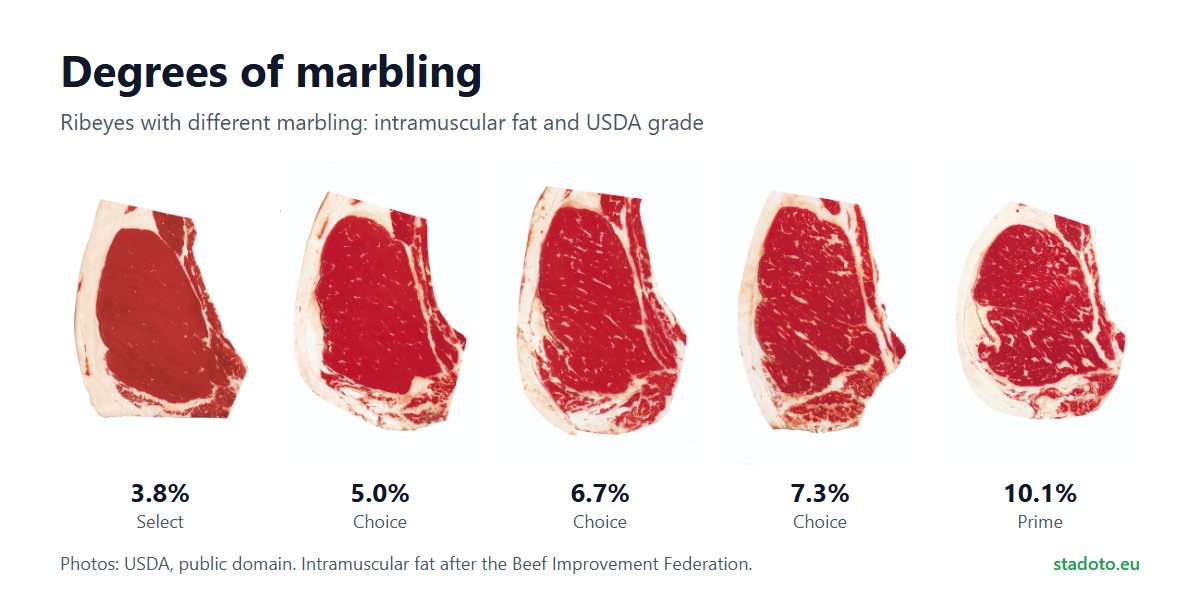
In the US, the grade of beef is set mainly by marbling and the age of the animal [6]. Marbling is judged in the ribeye, and each degree matches a certain percentage of intramuscular fat [5]:
| Degree of marbling (USDA) | Intramuscular fat | USDA grade |
|---|---|---|
| Slightly abundant | about 10.1% | Prime |
| Moderate | about 7.3% | Choice |
| Modest | about 6.7% | Choice |
| Small | about 5.0% | Choice |
| Slight | about 3.8% | Select |
| Traces | about 2.8% | Standard |
Prime comes from young, well-fed cattle and is sold mainly to restaurants [6].
The EU is different. Slaughterhouses classify the carcass on conformation (SEUROP) and fat cover from 1 to 5 [7]. Marbling plays no part in this classification, so a more marbled carcass does not get a higher price by itself. Marbled beef pays better through direct sales, restaurants and butchers, or under your own brand. Before you finish for marbling, find a buyer who pays for it. Otherwise the longer finish can lose you money.
What marbling depends on
- Genetics. The breed sets the ceiling: Angus is among the breeds with the most potential for marbling, and Wagyu is a specialist breed for even more. Within a breed, animals differ a lot. Carcass traits are highly heritable, so choosing the bull pays off quickly [4]. Look for bulls with a high breeding value for marbling (MARB or %IMF in Angus), based on progeny or ultrasound data. Selecting for marbling has no major downside for the herd, but do not choose a bull on one trait alone [4]. How Angus compares with other breeds is covered in our comparison of beef cattle breeds.
- Sex and castration. Bulls grow faster, but their carcass carries 20–35% less fat than that of comparable steers [3]. For marbled beef, steers and heifers are finished. Heifers lay down fat earlier and at a lower weight.
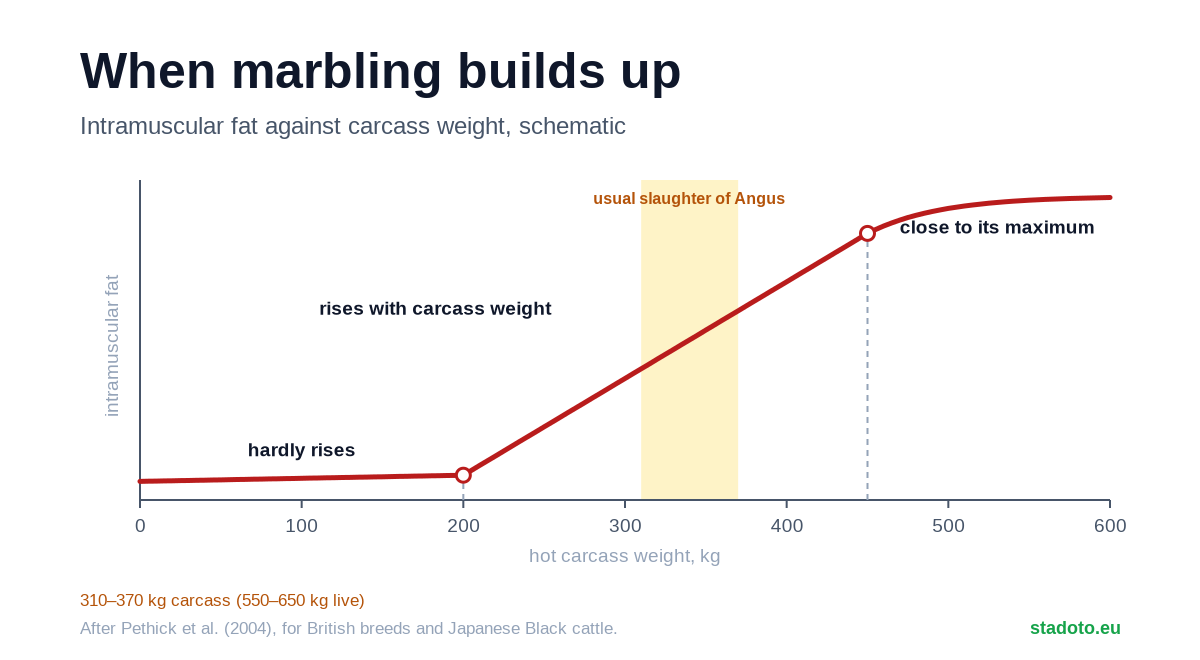
- Carcass weight. Intramuscular fat hardly rises while the carcass is below about 200 kg (about 360 kg live weight). Then it rises steadily with weight up to about 450 kg of carcass and levels off near the animal's mature size [1]. It builds up together with the other fat, not last [1]. So marbling comes with some fat cover, and a light carcass cannot be heavily marbled.
- Energy in the ration. During finishing, marbling responds most to more energy in the ration: more grain instead of grass, ground or rolled grain that is digested more fully, and a little added fat [1]. That is why beef finished on grass alone is usually less marbled than grain-finished beef.
- Growth without setbacks. If growth stalls before finishing, the animal starts finishing with less intramuscular fat and ends with less [1]. The cells that intramuscular fat cells form from are most plentiful early in life and become fewer with age. So the feeding of the cow in pregnancy and of the calf in its first months shows in marbling much later [2].
- Health. In a US study, calves with lung damage at weaning, at about 2 months, grew just as well, but at slaughter at about 16 months they were less marbled than healthy calves [8]. Pneumonia early in life costs marbling even when it does not show in weight.
How to feed Angus for marbled beef
Calf. The aim is a calf that grows well and without a break. A calf suckling its mother needs enough milk and good grazing, and the cow should be in good condition during pregnancy [2]. If you rear Angus or Angus crosses without their mother, see feeding a baby calf.
Growing to finishing. After weaning the animal grows on forage with a moderate amount of concentrate, usually at about 0.8–1.0 kg a day. It matters that it does not stall or lose weight, above all over winter: every setback now means less marbling at the end [1].
Finishing. Most marbling builds up here, once the carcass passes about 200 kg. The ration gets richer in energy, with more maize or barley, ground or rolled. Concentrate goes up in steps of at least 5 days, and forage never falls below 10% of the dry matter; on a small farm it is safer to stay above 15%. What the steps look like and how to spot acidosis is covered in detail in our fattening guide. In finishing, Angus gain 1.1–1.4 kg a day. Feed at the same times and the same ration: stress and sudden changes in eating harm marbling too.
How long. The heavier the carcass, the more intramuscular fat it has laid down, up to the animal's mature size [1]. So for marbled beef, Angus are finished for longer and to a higher weight than usual. But every further kilogram costs more feed, and the fat cover grows too. Agree with your buyer on what weight and finish pay best.
Why the sums are done on dry matter
Feeds hold very different amounts of water. 10 kg of maize silage with 33% dry matter (DM) gives 3.3 kg of DM, the same as 3.8 kg of maize grain with 87% DM. So a ration is worked out on DM and only then turned into kilograms to feed:
- DM, kg = fresh weight, kg × % DM ÷ 100
- Metabolisable energy, MJ = DM, kg × MJ per kg of DM
- Crude protein, kg = DM, kg × % crude protein in DM ÷ 100
- NDF, kg = DM, kg × % NDF in DM ÷ 100
- Fresh weight, kg = target DM, kg ÷ (% DM ÷ 100)
NDF shows the fibre in a feed. Have your silage and hay analysed when you can: typical values are only a starting assumption and do not replace a laboratory analysis.
Example rations
A 400 kg steer growing at 1.2 kg a day:
| Feed | Fresh weight | DM | Metabolisable energy | Crude protein |
|---|---|---|---|---|
| Maize silage | 12 kg | 3.96 kg | 42.8 MJ | 317 g |
| Meadow hay | 1 kg | 0.86 kg | 7.3 MJ | 82 g |
| Maize grain | 3 kg | 2.61 kg | 36.0 MJ | 235 g |
| Soybean meal | 1.2 kg | 1.06 kg | 13.9 MJ | 523 g |
| Total | 17.2 kg | 8.49 kg | 100 MJ | 1,156 g |
At this weight and gain the need is about 96 MJ, so the energy is enough for about 1.26 kg a day. The dry matter is 85% of the possible intake of 10 kg, the protein is 13.6% of DM, and forage makes up about 57% of the DM.
A 500 kg steer in finishing:
| Feed | Fresh weight | DM | Metabolisable energy | Crude protein |
|---|---|---|---|---|
| Maize silage | 8 kg | 2.64 kg | 28.5 MJ | 211 g |
| Wheat straw | 0.6 kg | 0.53 kg | 3.4 MJ | 21 g |
| Maize grain | 5 kg | 4.35 kg | 60.0 MJ | 392 g |
| Barley grain | 1.5 kg | 1.31 kg | 16.7 MJ | 150 g |
| Sunflower meal | 2 kg | 1.8 kg | 18.9 MJ | 648 g |
| Total | 17.1 kg | 10.62 kg | 128 MJ | 1,422 g |
A gain of 1.2 kg a day needs about 111 MJ, and the ration gives 128 MJ: the energy is enough for about 1.4 kg a day. That surplus of energy is the strongest lever for marbling [1]. The protein is 13.4% of DM and forage about 30% of the DM. Add minerals at the rate on the premix label.
The advanced calculator opens with the first example, in a new tab, so it stays beside the article. Change the weight, feeds and quantities to your own. With weaker silage the same ration gives less, so enter the values from your analysis if you have one. If you do not have such figures, the easy calculator on the same page suggests an example ration from five simple questions.
What the calculator does and does not do
The easy calculator suggests an example ration by stage from the feeds you have, and the advanced one adds up the dry matter, energy, protein and NDF of the ration you enter. Both compare it with the needs of the animal and warn you when forage or protein is low. An example ration is a starting point, not a recipe. The calculator does not check minerals, vitamins, starch or effective fibre, and it does not predict marbling: that also depends on genetics, sex and health.
In Stadoto you can save your feeds and rations, assign them to groups and see the gain each ration gave and what a kilogram of gain cost. More in the guide Feeding and costs.
Frequently asked questions
Does marbled beef earn a premium in Europe?
Not under the standard carcass classification. In the EU the carcass is classified on conformation and fat cover, and marbling is not assessed. A higher price comes from buyers who want premium beef: restaurants, butchers, and direct sales or your own brand. Agree the price before you start the longer finish.
Bulls or steers for marbled beef?
Steers and heifers. Bulls grow faster and eat less feed per kilogram of gain, but their carcass is leaner and less marbled. Heifers lay down fat earliest, so they are slaughtered at a lower weight.
Can grass-fed beef be marbled?
It can, but usually less than grain-finished beef, because grass gives less energy. Grass-fed beef has its own market. If the aim is well-marbled beef, a finish with more grain is needed.
How long are Angus finished for marbling?
Until the carcass reaches the weight and finish your buyer pays for. Marbling rises with carcass weight, so Angus for marbled beef are finished for longer and to a higher weight than usual. Every further kilogram costs more feed, though.
How do I choose a bull for more marbled beef?
Look at the breeding value for marbling in the catalogue: MARB or %IMF in Angus. The higher it is, the more marbled the progeny are expected to be. Prefer bulls with data from many progeny or from ultrasound, and do not choose on one trait alone: calving ease and growth matter too.
Sources
- D. W. Pethick, G. S. Harper, V. H. Oddy (2004) – "Growth, development and nutritional manipulation of marbling in cattle: a review", Australian Journal of Experimental Agriculture 44: 705–715 – DOI.
- M. Du et al. (2013) – "Manipulating mesenchymal progenitor cell differentiation to optimize performance and carcass value of beef cattle", Journal of Animal Science 91: 1419–1427 – DOI.
- M. McGee, Teagasc (2014) – Feed Efficiency in Beef Finishing Systems, slides.
- R. C. Vann, J. A. Parish, B. B. Karisch, Mississippi State University Extension (2021) – Using Live Animal Carcass Ultrasound Information in Beef Cattle Selection.
- Mississippi State University Extension – Ultrasound Scanning Beef Cattle for Body Composition, table after the Beef Improvement Federation.
- USDA Agricultural Marketing Service – Beef Grading Shields.
- Regulation (EU) No 1308/2013 establishing a common organisation of the markets in agricultural products, Annex IV – EUR-Lex.
- I. L. B. Fernandes et al. (2025) – "The association of lung consolidation in beef × dairy cattle at weaning with feedlot growth performance, carcass characteristics, liver health, and liver microbiome diversity", Journal of Animal Science 103 – PMC.
Ribeye photos: USDA, public domain.
This is general guidance for healthy animals. Before you change the feeding, have the ration checked by a ruminant nutritionist or your vet. Facts last checked: 15 November 2026.