
Can a cow calve every 365 days? The 82-day rule
One calf a year leaves only 82 days after calving to get the cow in calf again. Where the number comes from, why it is tight and how to get close to it.
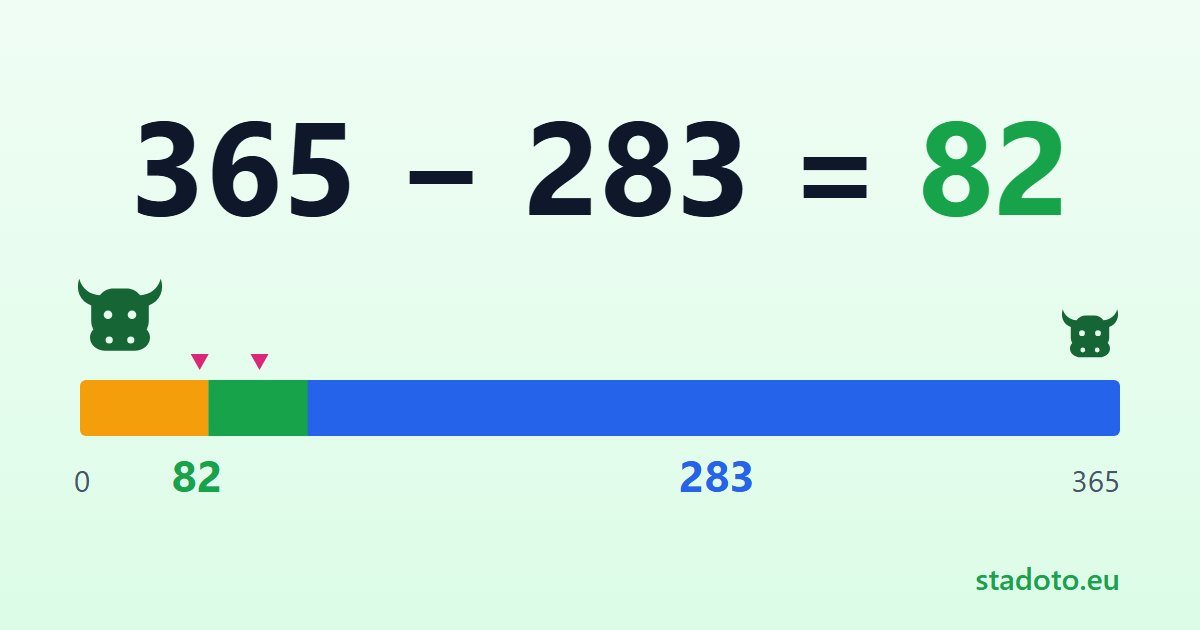
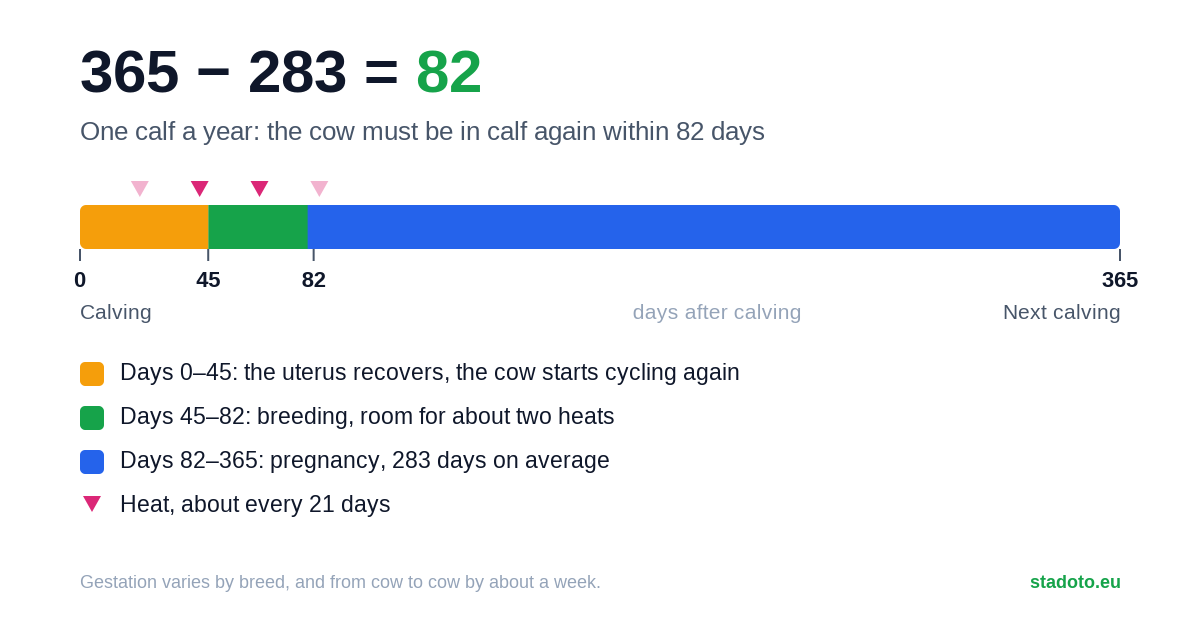
One calf per cow per year is the classic goal of a cattle farm: a 365-day calving interval. The arithmetic behind it is short. A cow is pregnant for about 283 days, so of the 365 days in a year only 365 − 283 = 82 days are left between calving and the next conception. Within 82 days of calving, the cow has to be in calf again.
What the calving interval is
The calving interval is the number of days from one calving of a cow to her next. It is made of two parts:
- days open: from calving until the cow conceives again, and
- gestation: from conception to calving, which the farmer cannot change.
Every day you want to save has to come from the days open.
Gestation depends on the breed
283 days is an average. Continental breeds usually carry a few days longer than British ones, and bull calves are carried a day or two longer than heifer calves. That changes how many days are left:
| Breed | Average gestation | Days left to conceive |
|---|---|---|
| Holstein | about 279 days | 86 |
| Aberdeen Angus | about 281 days | 84 |
| Hereford | about 285 days | 80 |
| Charolais | about 287 days | 78 |
| Simmental | about 288 days | 77 |
| Limousin | about 289 days | 76 |
These are averages: single cows vary by about a week either way.
Why 82 days are not many
The cow does not start on the day she calves:
- The uterus needs about 4–6 weeks to recover. A cow is usually not bred before about 45 days after calving (Stadoto counts 45 days of rest after calving unless you change it in the farm settings).
- A cow comes on heat about every 21 days (18–24 days) once she is cycling again. Between day 45 and day 82 there is room for only about two heats.
- Not every service ends in a pregnancy. With good fertility about half of them do, so two chances are enough for most cows, but not for all.
- Suckler cows often start cycling late, thin cows and first-calvers most of all. A cow that has not been on heat by day 60 has already lost one of her two chances.
Every missed heat moves the next calving back by about three weeks.
What a longer interval costs
- Fewer calves. With an interval of 400 days instead of 365, a cow gives about one calf less in ten years.
- Lighter calves at weaning. A calf born three weeks later is three weeks younger on weaning day. At a gain of around 1 kg a day, that is about 20 kg less to sell.
- A longer calving season. Calves of very different ages are harder to feed, treat and sell as one group.
In dairy herds the sums are different: high-yielding cows often do best with an interval of about 12.5–13 months. In a beef herd, where the calf is what you sell, 365 days remains the target.
How to get closer to 365 days
- Calving in good condition. Cows should calve neither thin nor fat: about 5–6 on the 1–9 body condition scale, or about 3–3.5 on the 1–5 scale. Thin cows start cycling later and conceive less often.
- Feeding before and after calving. Much of the next pregnancy is decided in the last two months before calving and the first two months after it. Enough energy, protein and minerals keep the cow from losing much condition after calving.
- Easy calvings. A hard calving, a retained placenta or an infection of the uterus delays the next pregnancy. For heifers choose bulls known for easy calvings, and call the vet for a cow that is unwell after calving.
- Heat detection. Watch the cows at least twice a day, early in the morning and in the evening, for 20–30 minutes. Note the heats from about three weeks after calving, even before you breed: then you know which cows are cycling. With natural service, have the bull checked before the season.
- Early pregnancy checks. A vet can confirm a pregnancy by ultrasound from about 30 days after service. An open cow found early can be bred again at her next heat.
- Heifers a little earlier. First-calvers need more time to start cycling again. Breed the heifers 2–3 weeks before the cows, so they calve earlier and have that time.
- A breeding season. In beef herds a breeding season of 60–90 days keeps the calvings together. A cow that does not get in calf during it is a candidate for culling.
The calving interval of your herd
Look at the average interval of the cows that have calved at least twice:
- 365–380 days: very good;
- 380–400 days: there is room to improve;
- over 400 days: look for the cause in condition, feeding, heat detection or health.
The average leaves out the cows that never got in calf again, so also count how many cows did not calve this year.
In Stadoto the Reproduction page shows the average calving interval of the herd and of each cow, and marks those over 400 days. Record the breedings and calvings, and the app shows when each cow is due. For a single cow, the calving date calculator gives the expected calving and the day of the pregnancy check. More in the guide Pedigree and reproduction.
And sheep and goats?
Ewes carry for about 147 days and does for about 150. Most breeds come on heat in late summer and autumn, so one lambing or kidding a year follows the season. Intensive flocks aim at three lambings in two years: an interval of about 8 months, or some 243 days, which leaves 243 − 147 = 96 days to conceive again and needs breeds that also breed out of season. The lambing and kidding date calculator works out the dates.
These are general guidelines for healthy herds. Hormone programmes and the treatment of fertility problems are a matter for your vet.